NIKOS MALATESTAS
Interview: Avgi Kalogianni
An optimistic Parian in challenging tasks
Nikos Malatestas is a low-key, serious and methodical person, with a deep love for Paros, committed to collective action and backed by a technological professional background. In recent years, he has undertaken challenging tasks, perhaps the most difficult one being the management of the organization that has been entrusted with Paros’s greatest endeavour: promoting the ancient marble quarries and securing their inclusion in the UNESCO list.
Is civic engagement, the concept of ‘active citizenship,’ intrinsic in the Parian community or rather a personal need of yours, a duty to your place of origin?
The starting point is emotional; it’s my love and concern for Paros, and the Cyclades in general. Origin plays a role, but more so do the special cultural and environmental features of this unique archipelago. Then, all the resources our life journey equips us with –our knowledge, experiences, skills, sensitivities– are activated to serve a vision of development that goes hand in hand with the preservation of the core identity of these places. The fact that many of us living on Paros share this outlook and sensitivity is certainly important.
We find you at the helm of the “CNPC Paros Ancient Marble Quarries Park.” How did the creation of this organization come about, what are its most significant achievements, its immediate and long-term goals?
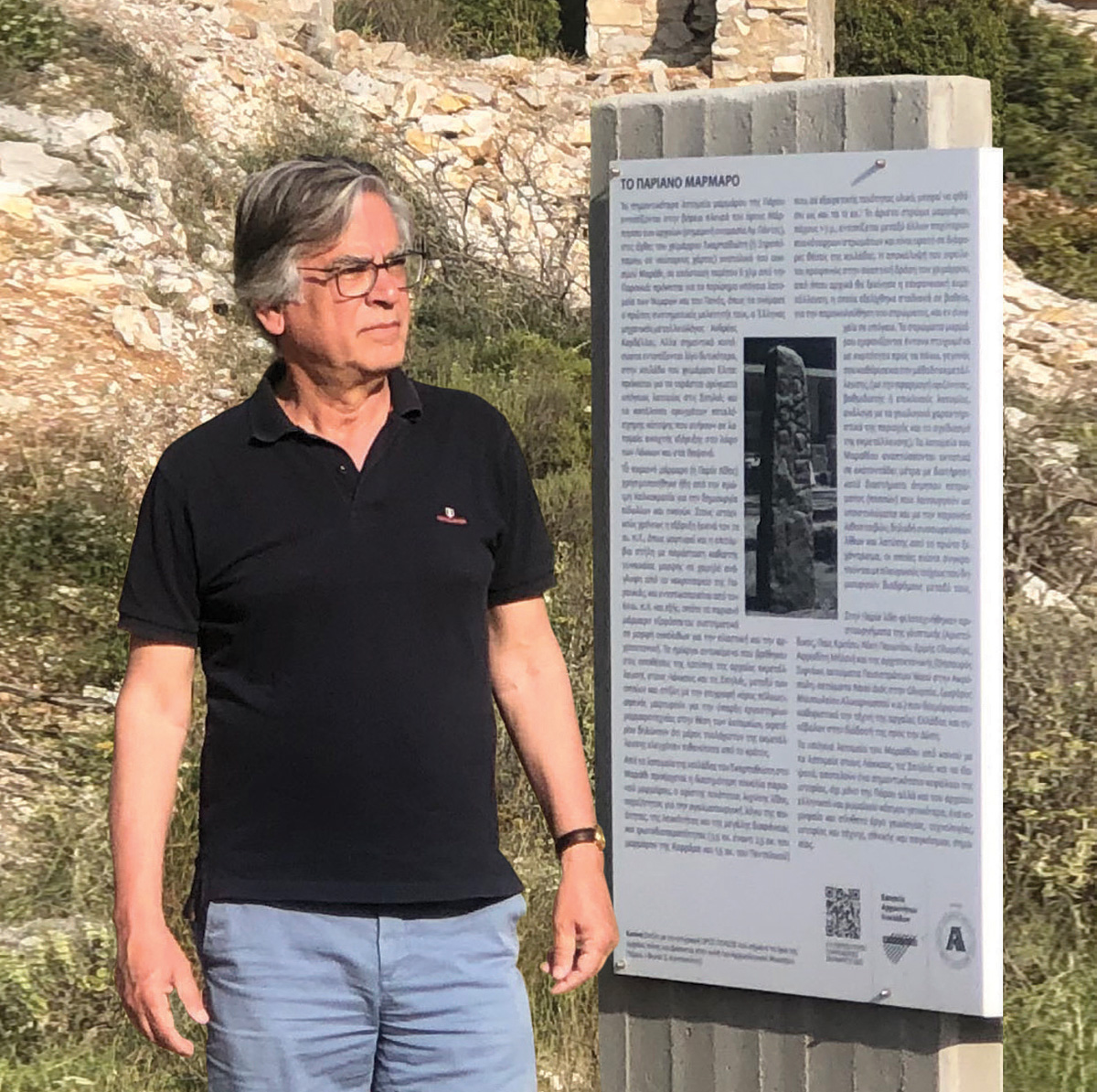
The CNPC was founded by six Paros-based collective organizations that have been involved in the cause of the ancient quarries in various ways. It has already accomplished remarkable work and has ambitious goals for the future. First of all, we have contributed to supporting important studies for the preservation of the underground galleries. We’re also working on resolving the ownership issues, so that the areas in question become municipal property. We’re trying to enhance the site and the first step in this direction was the installation of informational signage. We’re raising awareness of the importance of the monument with school events on Paros and elsewhere. Our immediate goals are continuing such initiatives and helping draft a master plan for the wider archaeological site. Our long-term goal is its inclusion in the UNESCO World Heritage monuments list.
Are you optimistic about the outcome of your mission?
Yes, I’m very optimistic. The CNPC administration consists of dedicated people with excellent cooperation. Our collaboration with the Ephorate of Antiquities and the Ministry’s Service for Modern Monuments is outstanding; the municipal government is a valuable ally fully sharing the goals of protection and promotion; a large part of local professionals and residents actively support our efforts; and many non-permanent residents contribute financially. Of course, one shouldn’t expect immediate or spectacular leaps of progress. Procedures in the Ministry of Culture are slow and time-consuming. However, we’re moving forward with steady steps and this will be made visible.
We also find you leading the ‘Environmental and Cultural Park of Paros.’ Tell us about this year’s Festival.
The Festival in the Park is a living entity and we want it to evolve and diversify. We’re expanding our scope –see, for example, the very successful recent puppet festival– but we’re also going beyond the boundaries of the Park with events throughout Paros. Surely, most of the events remain within the Park, featuring interesting concerts, as well as theatrical and dance performances. I wouldn’t like to mention some specifically, because I’d be doing injustice to the others –each is remarkable in its own right.
You are a civil engineer and have experience and opinions on practical and technical matters related to the smooth operation of the Municipality. What could be your contribution?
There are two domains to which I think I could have substantial contribution. The first concerns Paros’s urgent infrastructure needs –transportation, ports, flood protection and waste management. The second is implementing what we call reliable and long-term planning at every level of municipal operation. I’ve been fortunate to work for many decades in the design of large infrastructure projects and I firmly believe in the importance of both planning –an area where Greece often falls short –and robust infrastructure.
Do you think the challenge of sustainable tourism development can be met on an island like Paros?
It’s a tough undertaking. On Paros, a small island lacking long-standing traditions of organization and streamlined public administration, market forces seem to prevail, driving shortsighted growth. On the other hand, both on the island and, more broadly, in the public sphere, the demand for a development model that is not exclusively market-driven is growing, fuelled by environmental and cultural groups, scientific bodies, certain municipal authorities, journalists and media outlets, and an increasing number of citizens and islands residents —even if political entities largely remain uninvolved. I need to believe that all this mobilization will lead to change, given that Paros, at least, boasts a critical mass of people ready to create the conditions for this necessary transformation – as long as action is not delayed too long.