
Spolia: The stones tell their own story
NATASA BIZA: CHANGING PLACES / A STONE STORY
Spolia (Latin, “spoils”; sg.: spolium) are stones taken from an old structure and repurposed for new construction or decorative purposes.
Spolia (Latin, “spoils”; sg.: spolium) are stones taken from an old structure and repurposed for new construction or decorative purposes.
Paros has been my favourite site of research and study since my student years, especially the years of doctoral studies at Cornell University, USA, an institution of renowned academic excellence. There, in the context of an in-depth study of ancient Greek classical sculpture, I had the opportunity to get to know Skopas, a cosmopolitan Parian sculptor of the 4th century B.C., lesser known to the general public compared to the other great figures of his time, Praxiteles and Lysippus.
As from April 1941 during the Second World War, and after the initial victories of the Greek army against the Italian troops on the Albanian front, Greece found itself under a triple military occupation: by Germany, Italy and Bulgaria.
During the interbellum, when the first tinplate containers became available in the market, the first handmade karava (toy boat) made its first appearance on the island. Some grandfather or parent must have crafted a small tin boat for his child out of the olive oil or feta tin container that was lying about in the house.
From the 1920s onwards, the tourism industry has gradually emerged as one of the most critical pillars of the Greek economy, as well as, by and large, a factor of change for the physiognomy of Greece. All along this journey, some of the most prominent Greek visual artists, photographers and graphic designers have shaped, to a large extent, the (timeless) image of the country to the world.
Our country boasts numerous islands, probably too many, compared to its size. And yet, for many people, as there is only one mother, so there is only one island –their homeland. And for us, too, here at Parola, there is one and only island, and this is Paros.
An island in advanced adolescence, right in the prime of its youth. An island at its peak moment –this is what Paros was like back in the 1980s. A true destination of respite and relaxation in an era of unmitigated innocence depicted through the black and white allure of a photo collection.
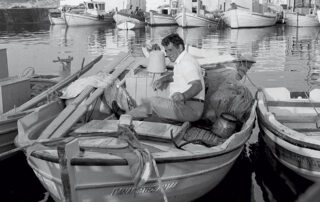
What’s Paros like today? What was it like in the 1950s and what did it look like until a few years ago when it started functioning as a gold mine, and invaders, miners, gold miners and a host of pirates sailed their way here? Once, we used to wait for the "Myrtidiotissa" (a large caique boat looking like a steamer in our eyes) to enter the port twice a week.
Preserving fish in salt –salt-curing– is an ancient Mediterranean technique aimed at storing and preserving fish outside the refrigerator, and feed fishermen’s families in the harsh winter months.
The last great naval combat waged with wooden sailboats, the naval battle of Navarino (1827), finalized the independence of Greece. The allies, the British, the French and the Russians, defeated the fleet of the Ottoman Sultan Mahmud II, reinforced by Muhammad Ali Pasha of Egypt’s fleet.